
There’s a moment just before you commit to something terrifying, when every instinct tells you to step back. To wait. To rethink.
Brian Wood MC stood in that moment – crampons biting into a slab of ancient Scottish ice, breath punching the cold air – when he realised he was about to climb something he had no business climbing.
And that was exactly why he was there.
It began with a conversation – not on a mountainside, but in the warm stillness of the Veterans for Veterans podcast studio. Brian had been talking through the brutal ultra‑marathon he’d recently completed in Sweden, a race fought across frozen ground and endless silence. It was the kind of challenge that strips a person back, revealing something raw beneath the uniform and medals. Listening opposite him was Jay Morton, who knew extremes well enough to see immediately that Brian wasn’t finished; he was already reaching for the next challenge.
“What next?” Woody asked.
“We should go ice climbing in Scotland.” Jay responded.
The idea that flicked into Jay’s brain was said out loud with the kind of casual nonchalance reserved for everyday plans, not frozen cliff faces. Brian immediately agreed. Not because it made sense, but because something in him knew it needed to be done.
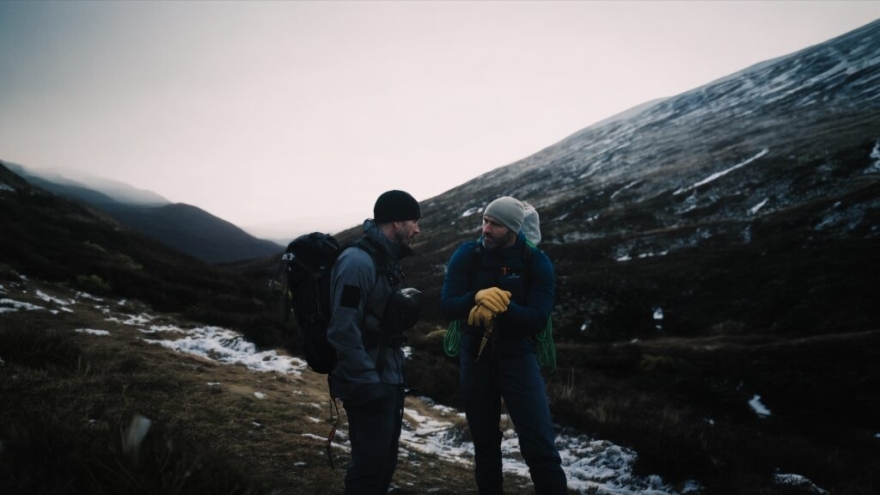
The Cairngorms in winter are not a place you enter casually. The wind cuts across the plateau with an edge that feels older than memory, and the mountains stand tall, iced in thick, glass‑hard layers that turn every surface into a test. This was the landscape Brian stepped into – not as a soldier, nor as an athlete, but as a complete beginner. The cold alone felt like a different kind of opponent.
Before Brian took his first swing, Jay walked him through the essentials: how the axes should feel when they bite properly, how the front points of the crampons need to drive into the ice, and how staying close to the wall creates balance rather than a battle. His calm, methodical coaching set the tone for the climb ahead.
Matthew Pavitt joined them as second climber – a professional mountaineer and climber Jay often relied on during his own expeditions. Matt brought a depth of experience and leadership that balanced Jay’s grounded, hands‑on guidance needed at the base of a climb like this.
Climbing with the practiced precision of someone who treats vertical ice the way others treat a familiar road, Jay moved efficiently up the frozen face first, setting the anchor with calm, deliberate confidence. Once the rope dropped cleanly back down the wall, Brian stepped forward to begin his ascent.
There was no bravado in Brian’s first few movements, only concentration. The ice didn’t give in easily. His swings bounced off or skimmed the surface, requiring patience rather than strength. Slowly, the technique began to land. The third, fourth, fifth placements found their grip. He wasn’t ready to give up. Not yet.
Halfway up, the physical reality began to make itself known. The cold pressed through his gloves with a slow, deliberate persistence, stiffening his hands until they felt heavy and unresponsive around the handles of the axes. Each placement demanded more focus than the last, and his fingers began to resist the simple commands he sent them. Brian knew this sensation well; Non‑Freezing Cold Injury (NFCI) had been an unwelcome companion throughout his military career, a reminder of long operations and harsher environments. Now, on the ice wall, that familiar numbness crept back in, as an added layer to the challenge.
Above him, Jay called down periodic guidance, his voice clear and measured, while Matt stayed close beside him, ready with a corrective word or steadying instruction whenever the ice demanded it.
But something shifted as Brian felt the familiar sting of his cold injury starting to set in. Instead of stopping, he pressed on, refusing to let it dictate the climb. The mental battle began to outweigh the physical strain, sharpening his focus rather than dulling it. His movements steadied, each placement becoming more deliberate. He found the rhythm -swing, kick, breathe, repeat – and the climb started to make sense. The height faded into the background, and the cold no longer called the shots. What remained was the challenge he’d come looking for, and he leaned into it fully.
When he reached the finishing point, he paused, the way a person pauses when they know they’ve just crossed an invisible line within themselves. Jay reached out a hand to steady him; Matt followed with a quiet nod that said everything the moment needed. Only then did Brian turn back to look at the wall he had just climbed, taking in the vertical stretch of ice that had, in its own way, tested him as deeply as any race.
Success wasn’t measured in height gained or technique mastered. It was measured in willingness. The decision to be a beginner again, to step into something unfamiliar, to learn under pressure, and to push through discomfort without any guarantee of triumph. It’s a feeling many veterans know well; life after the military often asks you to start over, stretch yourself in new ways, and keep pushing boundaries long after service ends.
Brian Wood MC didn’t go to the Cairngorms to prove that he was unshakeable. He went to confront that same split‑second fear he’d felt at the base of the climb. The moment where instinct urges retreat, yet something deeper insists you move anyway. He later admitted, “This is probably the toughest endeavour I’ve ever done,” but he pushed into the unknown regardless, choosing challenge over certainty.
In doing so, he closed the loop he started the day he said yes: stepping forward when stepping back would have been easier. It’s a moment a lot of veterans will recognise: you take a breath, tighten your kit, and crack on because turning around was never really on the table.